One Quality Platform. One Connected Workflow.
Four layers. The boundaries between them are where quality work usually leaks — re-typed characteristics, documents that disagree, evidence collected by hand. Here they are the same system.
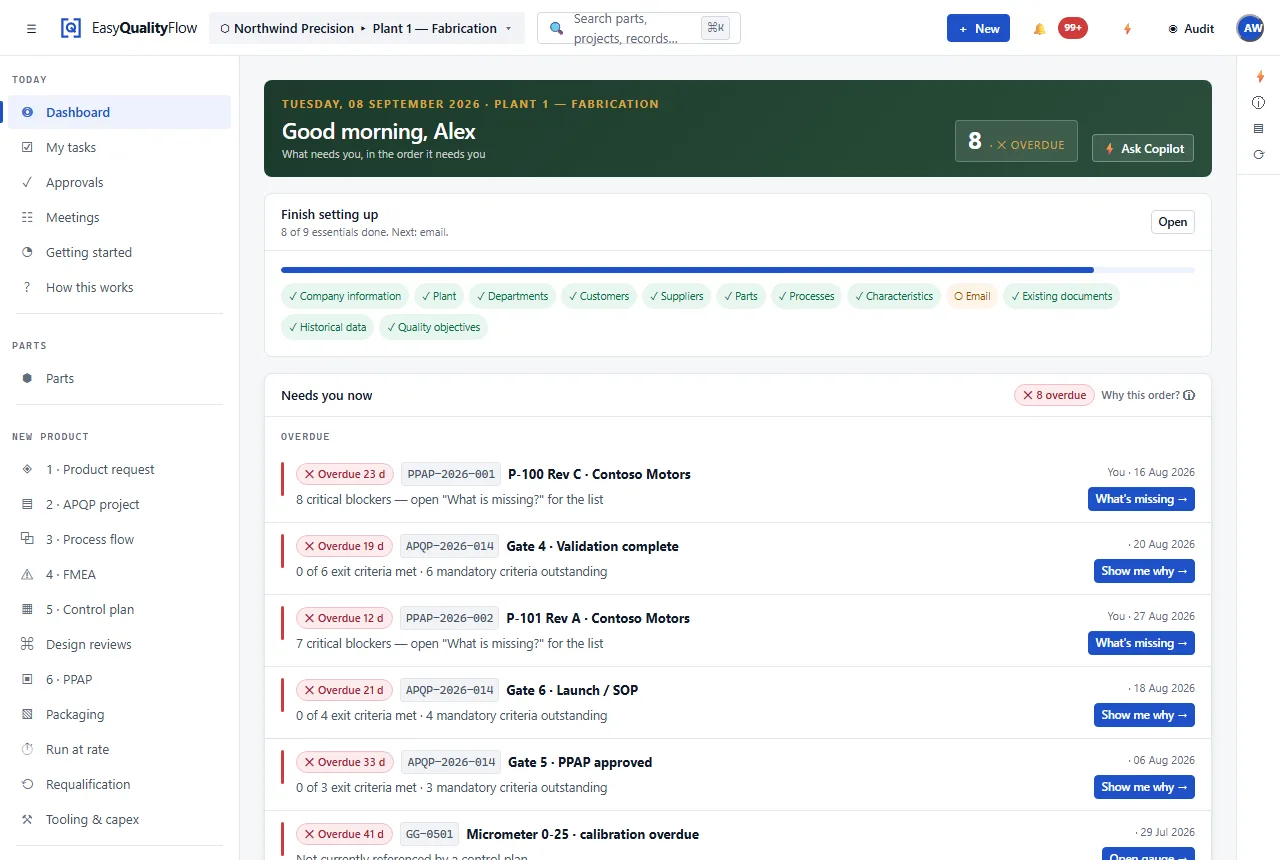
The connections are the product.
Any vendor can list modules. What matters is what each one hands to the next, because that hand-off is the work your team currently does by retyping. Select a stage.
What is in the platform today
Everything listed here exists in the product now. Roadmap items are on the homepage, clearly marked as roadmap.
Product lifecycle
What a part goes through once, from first drawing to approved submission.
Parts
The part record: number, revision, customer, drawing, and the characteristics taken from it. This is the single source every later document references.
APQP
Projects with phases and activities, owners, due dates, approvals and the documents each activity produced.
PPAP
Submission elements set by the customer’s requirement profile, with evidence linked to the records that satisfy them.
Risk & process
What could go wrong, and what is done about it.
FMEA
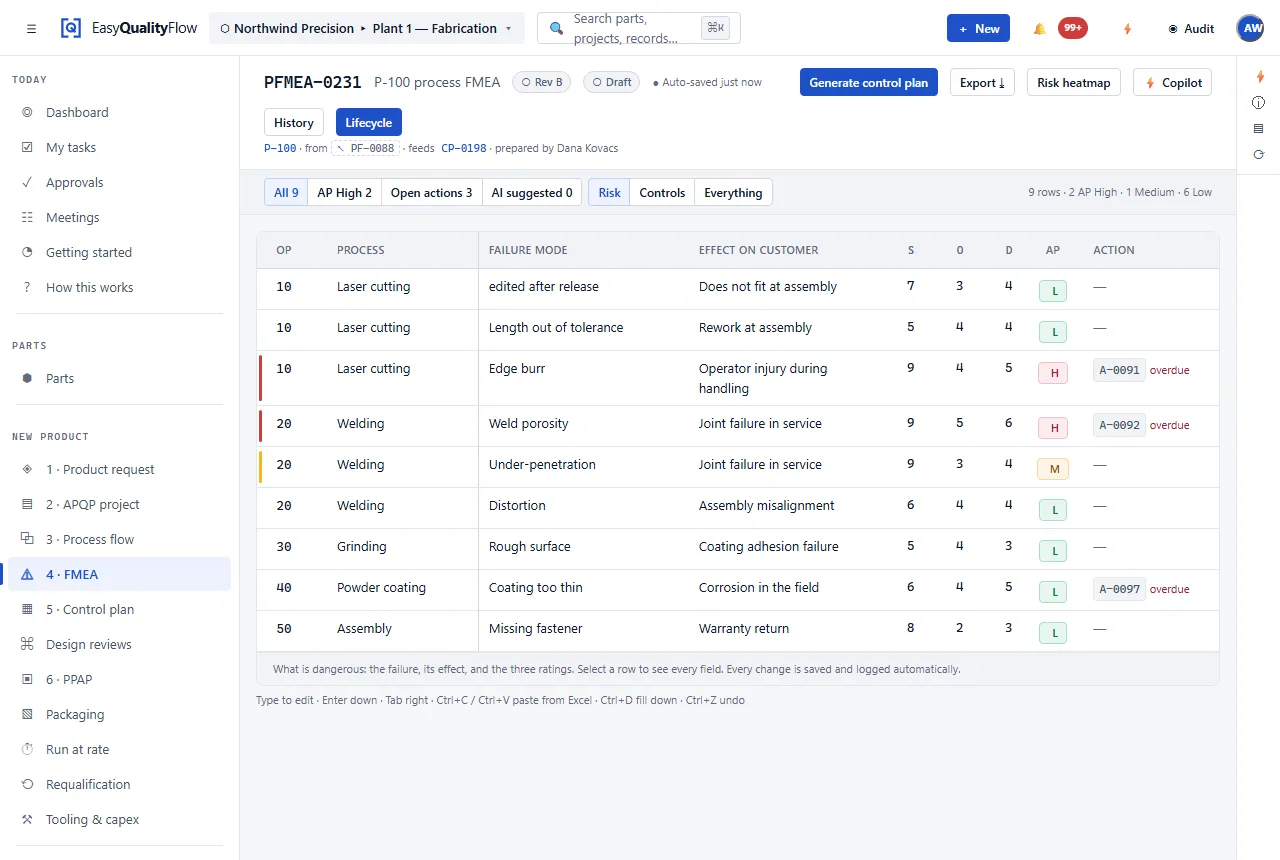
DFMEA and PFMEA in AIAG-VDA structure — failure modes, effects, causes, prevention and detection controls, risk evaluation and actions — with revisions and a Draft → Review → Released workflow.
Process
The operation sequence and which characteristics each operation makes or verifies. The spine both the PFMEA and control plan are built on.
Control Plan
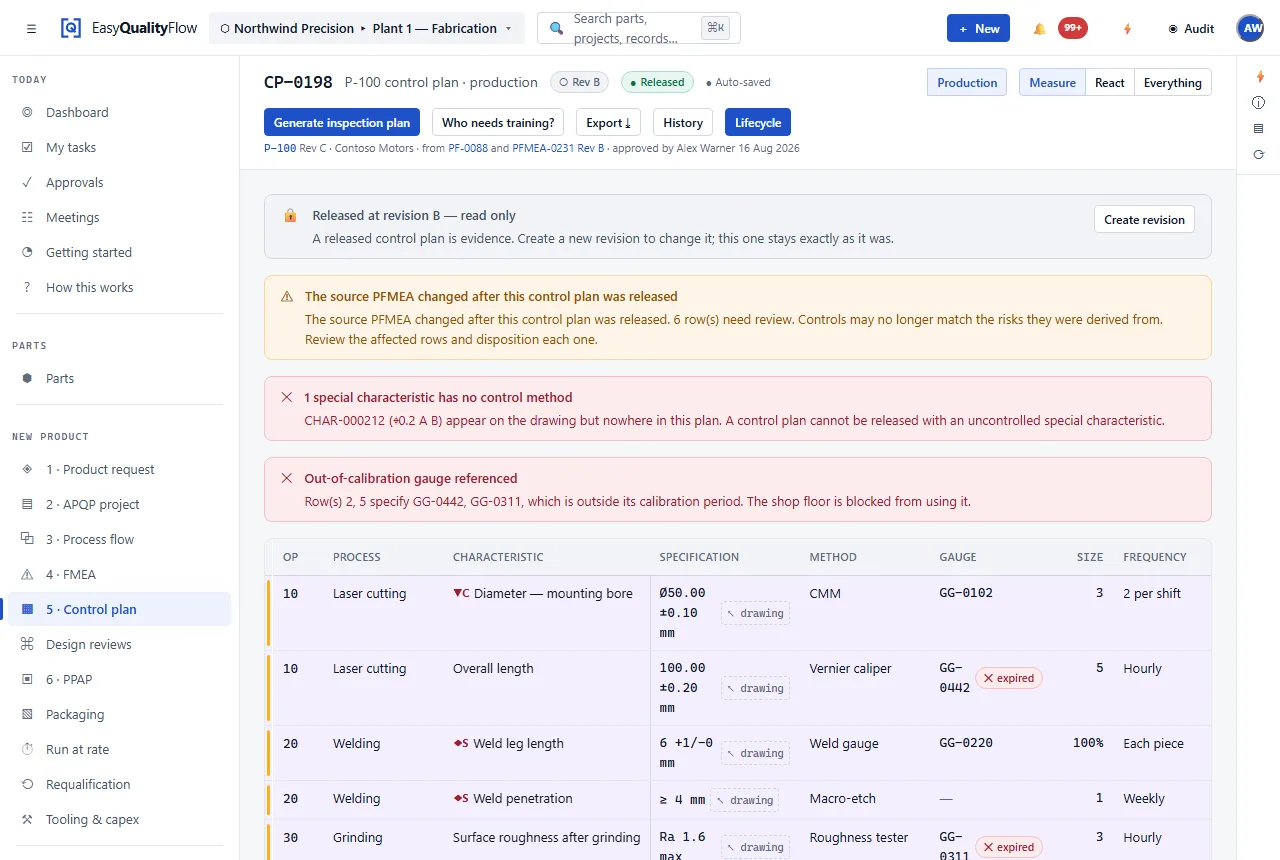
What is measured at each operation, to what specification, with which gauge, how often, and what happens on a failure.
Quality execution
Measured reality, and what it says about the process.
Inspection
Results against specification, with the gauge used and its calibration state, recorded per characteristic.
SPC
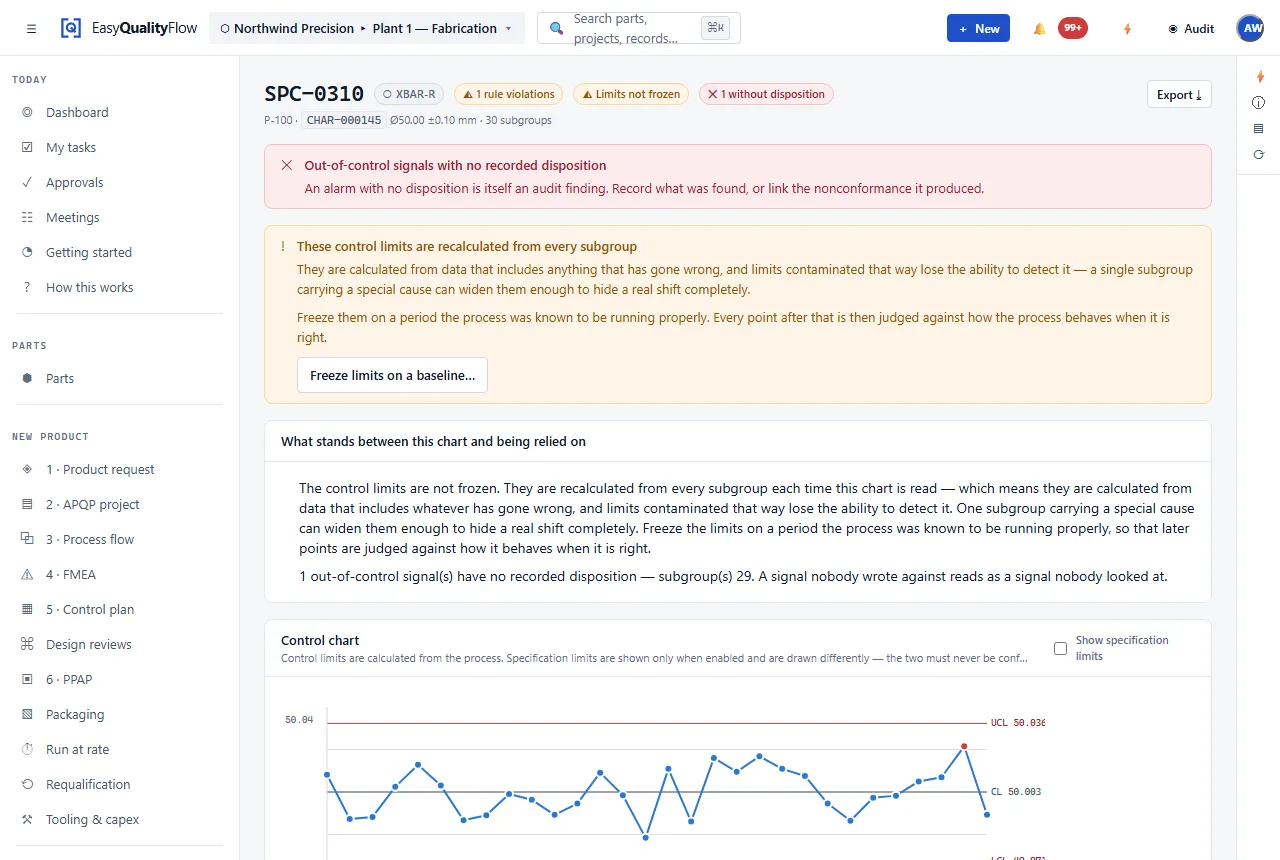
X̄–R control charts with calculated limits, Nelson rules for out-of-control signals, and Cp / Cpk / Pp / Ppk.
Governance
What makes the records above hold up.
Quality
Nonconformances, 8D investigations and corrective actions, linked to the part and the process.
People & Gauges
Who is qualified for which work, and which gauge is in calibration — both of which an inspection result depends on.
Customer
The customer record every submission, requirement and profile hangs from.
Customer Requirements
What one specific customer asks for, held against that customer rather than in a shared folder.
Requirement Profiles
A reusable rule set per customer: required elements, naming, sequence, approval roles, submission rules.
Approval Routes
Who approves what, in which order, before a document can be released.
Documents
Controlled documents with revision, version, owner, state, effective date and change reason.
Form Templates
The output format a customer expects, produced from the structured record.
Ready to simplify your quality workflow?
Bring APQP, FMEA, PPAP, process flow, control plans, inspection and SPC into one connected platform.
Questions? support@easyqualityflow.com