Quality Document Management Software
Document control is not storage. It is knowing which revision is in force, who approved it, and who is working to the old one.
Already have an account? Login
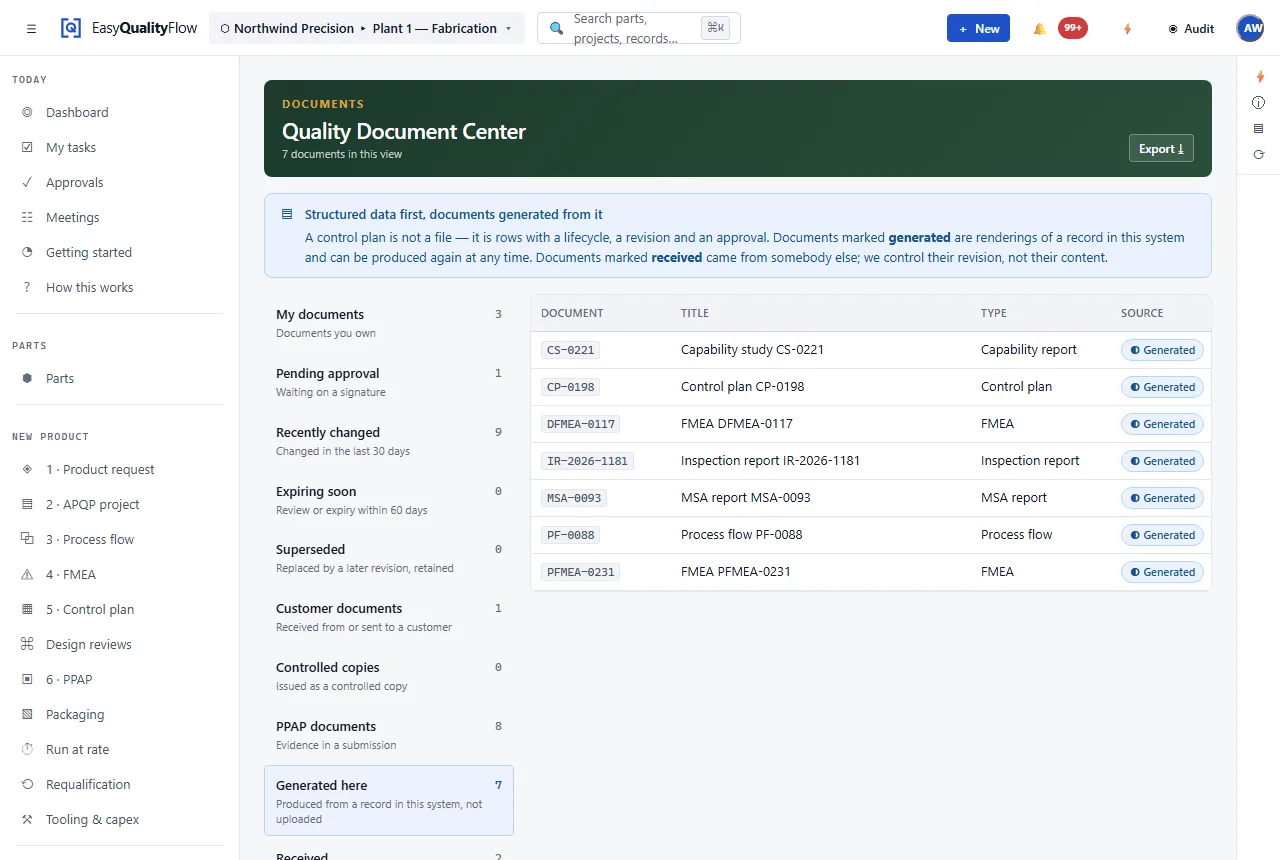
A shared folder cannot tell you who is working to the wrong revision.
The failure is rarely that a document is missing. It is that revision B is on the shop floor while revision C sits approved in a folder, and nothing in the system knows the difference. Distribution and acknowledgement are the parts a file share cannot do.
The second failure is the four-level structure. A manual, procedures, work instructions and formats are different kinds of document with different review cycles and different audiences, and flattening them into one folder tree is what makes an audit slow.
Controlled revisions
An approved document is superseded by a new revision, never quietly edited, and the history stays readable.
Approval routes
Who approves what, in which order, before a revision can be released.
Distribution and acknowledgement
Who holds a copy, and who has confirmed they have read the current one.
Four-level structure
Manual, procedure, work instruction and format, each in its place in the pyramid.
Clause coverage
Which clause of the standard each document answers, and which clauses nothing answers yet.
Change impact
What a document change touches — which training, which processes, which records.
A controlled document and a record are not the same thing.
The procedure that says how to inspect is a controlled document. The inspection result is a record. Mixing the two is the most common mistake in the first week, and the product keeps them apart deliberately.
- Revision control with supersession, not overwriting
- Configurable approval routes before release
- Distribution lists and acknowledgement tracking
- Four-level documentation structure
- Clause coverage across the standard
- Change impact across training and processes
Connected capabilities
Every one of these works on the same record. That is the point of the platform.
Questions about Document management
What is the difference between a controlled document and a record?
What happens to the old revision when a new one is released?
Can we require acknowledgement?
Does it generate our procedures for us?
Know which revision is actually in use.
Bring APQP, FMEA, PPAP, process flow, control plans, inspection and SPC into one connected platform.
Questions? support@easyqualityflow.com