CAPA Software for Corrective and Preventive Action
Most corrective actions correct a part. A CAPA that works corrects the reason the part was made that way — and then checks that it did.
Already have an account? Login
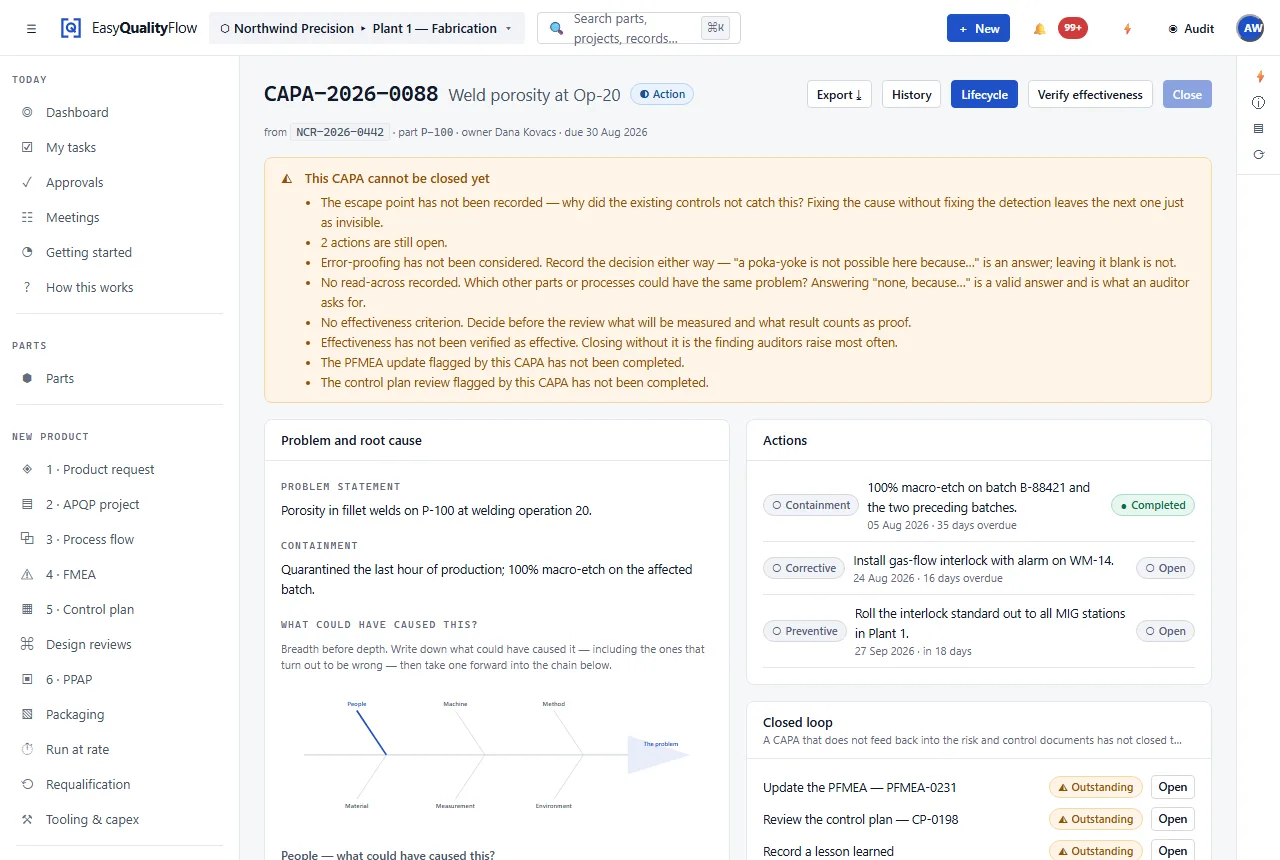
The two failures of a CAPA system are closing early and closing narrow.
Closing early means marking an action complete because the task was done, without evidence the problem stopped. Effectiveness verification exists precisely to make that impossible, and it is the step most often skipped when the CAPA lives in a spreadsheet with a status column.
Closing narrow means fixing one part number when the same process makes eleven. Read-across is the question "where else does this apply?" asked while the investigation is still open, rather than a year later when it happens on a different line.
Containment before cause
What is protecting the customer now is recorded first, and separately from the permanent fix.
Root cause, structured
Five-why and fishbone as data, so the reasoning can be reviewed rather than admired.
Corrective and preventive, kept apart
Correcting this occurrence and preventing recurrence are different actions with different owners.
Effectiveness verified
A CAPA cannot be closed on assertion — the check is a step with its own evidence and date.
Read-across
Which other parts, processes and lines share the cause, asked as part of the investigation.
Systemic view
Repeat causes across CAPAs are visible, which is how a pattern stops being eight separate incidents.
A CAPA is only finished when the system changed.
Raised from a nonconformance, an audit finding or a complaint; closed into a changed FMEA, a changed control plan or changed training. The last link is what makes it preventive.
- Containment recorded separately from the fix
- Five-why and fishbone as structured data
- Corrective and preventive actions tracked apart
- Effectiveness verification required before closure
- Read-across to similar parts and processes
- Repeat-cause visibility across CAPAs
Connected capabilities
Every one of these works on the same record. That is the point of the platform.
Questions about CAPA software
What is the difference between corrective and preventive action?
What is effectiveness verification?
What is read-across?
Can a CAPA come from an audit finding?
Close the cause, not the ticket.
Bring APQP, FMEA, PPAP, process flow, control plans, inspection and SPC into one connected platform.
Questions? support@easyqualityflow.com