Manufacturing Quality Software, End to End
Eight stages, one record. From the characteristic on the drawing to the submission the customer approves, without retyping the same number into a fifth spreadsheet.
Already have an account? Login
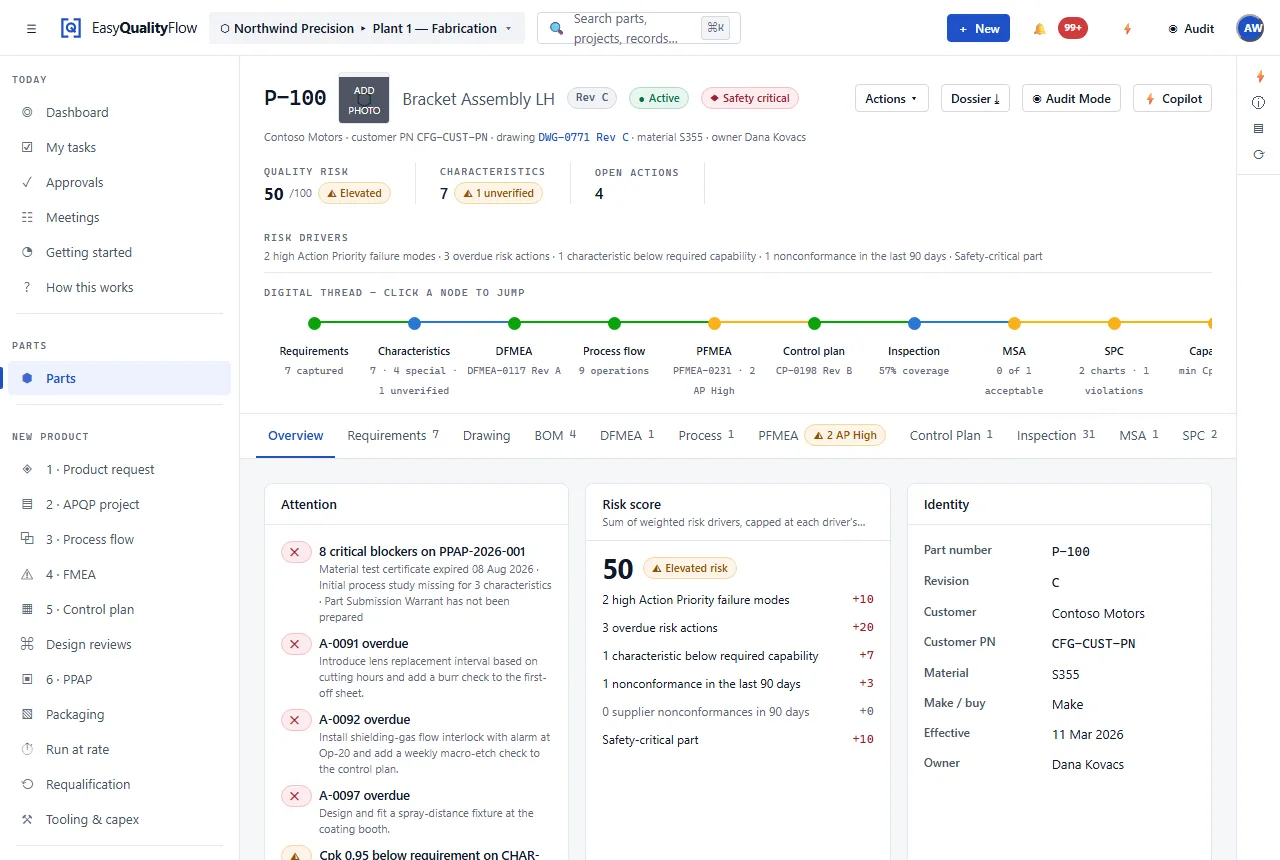
The cost is not the work. It is the reconciliation.
Quality departments are not inefficient because they lack effort. They are inefficient because the same characteristic exists in the drawing, the process sheet, the FMEA, the control plan, the inspection sheet and the submission — six times, entered by hand — and a revision means finding all six.
Connecting them is not a productivity trick. It changes what a revision costs, and it changes what an audit costs, because evidence can be gathered by scope instead of by memory.
Enter once, reference everywhere
A characteristic is created on the part and referenced downstream, never retyped.
Derivation between documents
Process operations become PFMEA rows; PFMEA controls become control plan lines.
Deterministic, not guessed
The hand-offs follow explicit rules. There is no model deciding what your control plan says.
Never overwrites a person
A derivation proposes; a value a human has set is left alone.
Revision-aware throughout
Records know which revision they belong to, so evidence stays attached to its version.
Evidence by scope
Records for a customer, part, process and date range, gathered by query rather than by hand.
The whole chain, and what each stage hands on.
This is the sequence the product is built around. Select any stage to see what it passes to the next one — the hand-offs are the product.
- Parts and characteristics as the single source
- APQP planning connected to its deliverables
- DFMEA and PFMEA in AIAG-VDA structure
- Process flow and control plan on one operation list
- Inspection results with gauge and calibration state
- SPC charts and capability from recorded results
- PPAP assembled from the records above
Connected capabilities
Every one of these works on the same record. That is the point of the platform.
Questions about Manufacturing quality software
What does "connected" actually mean here?
Is the derivation between documents automatic?
Is any of this AI?
Which industries is it for?
How do we get our existing data in?
Connect the whole quality workflow.
Bring APQP, FMEA, PPAP, process flow, control plans, inspection and SPC into one connected platform.
Questions? support@easyqualityflow.com